 How-to
How Often Should Sewer Lines Be Cleaned?
Last Updated: November 4, 2026
Quick Summary
Most homes should have their main sewer line cleaned every 18 to 24 months, but how often should sewer lines be cleaned depends on pipe material, tree roots, and home age. Newer PVC lines may go 2 to 3 years, while older cast iron or clay lines often need service every 12 to 18 months.
- A backup affecting more than one drain at once points to a main line clog, not a single fixture.
- Pre-1970 homes should get a camera inspection first, then cleaning every 12 to 18 months if roots or scale are present.
- Never pour cooking grease down the sink; wipe pans into the trash instead.
- Hydro jetting removes grease, scale, and roots and restores the full pipe diameter, but needs a camera check first on older lines.
- A professional cleaning runs a camera inspection, mechanical cleaning, then a final camera check to confirm the line is clear.
Table of Contents
- How Often Should Sewer Lines Be Cleaned? The Short Answer
- Signs of a Clogged Sewer Line You Should Never Ignore
- What Actually Sets Your Cleaning Schedule: Pipe Material, Tree Roots, and Home Age
- How to Keep Sewer Lines Clean Between Professional Visits
- Drain Snaking vs. Hydro Jetting: Which Cleaning Method Fits Your Clog
- What Happens During a Professional Sewer Line Cleaning
- Main Sewer Line Cleaning Cost: What Drives the Price
- Book a Sewer Line Inspection Before the Next Backup
- Frequently Asked Questions
How Often Should Sewer Lines Be Cleaned? The Short Answer
Most homes should have their main sewer line cleaned every 18 to 24 months. That's the baseline.
The homeowners who call in a panic are often the ones who waited for a backup.
So how often should sewer lines be cleaned, really? A newer home with PVC pipe and no trees nearby might stretch three years between cleanings.
Below, we'll break down the signs that mean you're overdue, how pipe material and tree roots change the math, and what actually happens when a technician shows up.
Signs of a Clogged Sewer Line You Should Never Ignore
The clearest sign of a clogged sewer line is a backup that affects more than one drain at once. If your toilet gurgles when the shower runs, or water pools in the tub after you run the washing machine, the blockage is in the main line, not a single fixture.
Other warning signs we see on service calls:
- Slow drains in multiple sinks, tubs, or showers
- Gurgling sounds coming from toilets or floor drains
- Sewage odor in the yard or basement
- Water backing up in the lowest drain in the house
- Soggy patches or unusually green grass over the sewer lateral
Main Line Backup vs. a Single Slow Drain
A single slow drain usually means a local clog: hair in the bathroom sink, grease in the kitchen trap. A main line backup hits several fixtures at once, and it gets worse fast. The difference matters because snaking one fixture won't fix a main line problem.
If the warning signs point to something serious, it's worth understanding what happens if your sewer line collapses before the problem escalates.
What Actually Sets Your Cleaning Schedule: Pipe Material, Tree Roots, and Home Age
Three factors decide your real cleaning interval: pipe material, root intrusion, and the age of the home. A 1950s house with clay or cast iron pipes and mature trees will almost always need more frequent service than a 2015 build with PVC. The generic 18-to-24-month advice collapses all three into one number, which is why it fails on older properties.
Tree roots are the biggest wildcard. Roots find hairline cracks at pipe joints and grow into them, hunting moisture. Once inside, they catch grease and paper and form a blockage. Homes with large trees near the sewer lateral may benefit from more frequent inspections than homes without them.
How Pipe Material and Climate Change the Timeline
Pipe material changes how fast things go wrong, and it should change the interval you book:
- Cast iron: rusts from the inside, roughens, and snags debris. Older cast iron often needs cleaning every 12 to 18 months. Scale buildup narrows the bore over time, so a camera check before each cleaning tells you whether the pipe is losing diameter.
- Clay pipes: crack at the joints, which is exactly where roots get in. Annual checks are wise, and any root cut should be followed by a camera pass to confirm the joint is still sound.
- Orangeburg (bituminous fiber): common in homes built roughly 1945-1972, this material deforms and collapses under load. It cannot tolerate aggressive hydro jetting; camera-first inspection is mandatory, and replacement is often the only durable fix.
- PVC: smooth and root-resistant at the seams. Every 2 to 3 years is usually enough, and many PVC lines with no tree load can stretch longer if flow is unrestricted.
- Concrete: joints separate and the material erodes in acidic soil. Treat it like clay for inspection frequency.
Climate plays a role too. In dry regions, roots push harder toward pipe moisture. In cold regions, freeze-thaw cycles stress older joints and can shift pipe bedding, creating bellies where waste pools. Neither factor is in the generic 18-to-24-month advice, but both show up on real service calls.
Home Age Correlation: A Practical Decision Rule
Home age is the fastest shortcut to a schedule because it tells you what is likely underground:
- Pre-1970 homes: assume cast iron, clay, or Orangeburg until a camera says otherwise. Book an inspection first, then set cleaning at 12-18 months if roots or scale are present.
- 1970-2000 homes: often cast iron transitioning to PVC. Every 18-24 months is reasonable, with annual camera checks if mature trees sit over the lateral.
- Post-2000 homes: typically PVC with fewer root seams. Every 2-3 years, or on signs of a slowdown.
Watch out: a cleaning interval set by calendar alone can miss a cracked joint or a developing belly for a full cycle.
If you do not know your pipe material, that is the first thing to establish. The interval follows from the material, the tree load, and the camera result, in that order.
The right interval comes down to what your pipe is made of and how old the home is.
| Pipe material or home age | Suggested interval | Note |
|---|---|---|
| Cast iron | Every 12 to 18 months | Rusts inside and snags debris |
| Clay pipes | Annual checks | Cracks at joints where roots enter |
| Orangeburg | Camera-first inspection | Cannot tolerate aggressive hydro jetting |
| PVC | Every 2 to 3 years | Smooth and root-resistant at seams |
| Concrete | Treat like clay | Joints separate and material erodes |
| Pre-1970 homes | 12-18 months if roots or scale | Assume cast iron, clay, or Orangeburg |
| 1970-2000 homes | Every 18-24 months | Annual camera checks with mature trees |
| Post-2000 homes | Every 2-3 years | Typically PVC with fewer root seams |
How to Keep Sewer Lines Clean Between Professional Visits
Prevention comes down to what goes down the drain and what grows near the line. Most backups we see are avoidable with a few habits.
- Never pour cooking grease down the sink. Wipe pans into the trash instead.
- Use drain screens in tubs and showers to catch hair.
- Flush only toilet paper and waste. No wipes, even "flushable" ones.
- Run hot water for 30 seconds after each sink use to move residue along.
- Know where your cleanout access is, and keep it clear.
- Watch for slow drains and deal with them early.
If you've had more than one backup in a year, the problem isn't your habits. It's the pipe. For a deeper prevention plan, read our guide on preventing recurring sewer backups.
Drain Snaking vs. Hydro Jetting: Which Cleaning Method Fits Your Clog
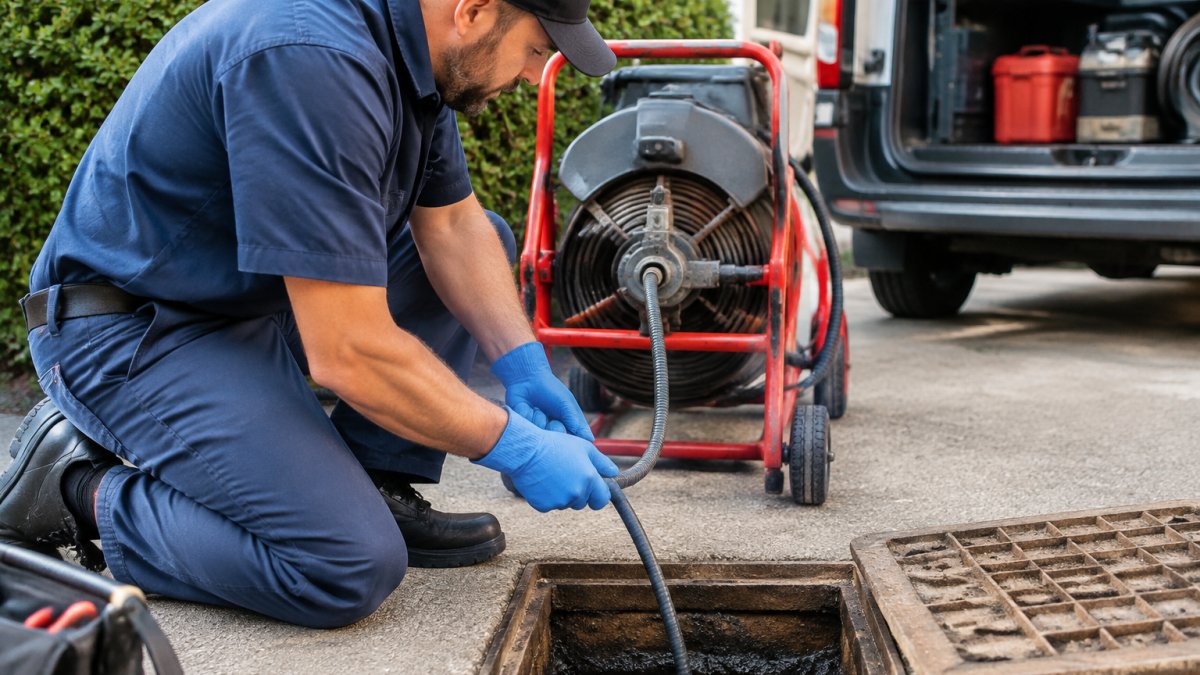
Drain snaking cuts through a clog with a rotating cable. Hydro jetting blasts the pipe walls clean with high-pressure water. Snaking handles a single soft blockage.
Choose snaking when you have one localized clog and the pipe is in decent shape.
One caution: hydro jetting on fragile, old cast iron or clay pipe can do damage. A camera inspection first is not optional on older lines.
What Happens During a Professional Sewer Line Cleaning
A professional sewer line cleaning starts with a camera inspection, then moves to mechanical cleaning, then a final camera check to confirm the line is clear.
Here's the sequence we follow:
- Locate the cleanout access and open it.
- Run a sewer camera to find the blockage, measure its distance, and check pipe condition.
- Clear the line with the right tool, either a snake or hydro jetter, based on what the camera showed.
- Re-inspect to confirm the blockage is gone and the pipe is intact.
- Report findings and flag any cracks, roots, or bellies that need repair.
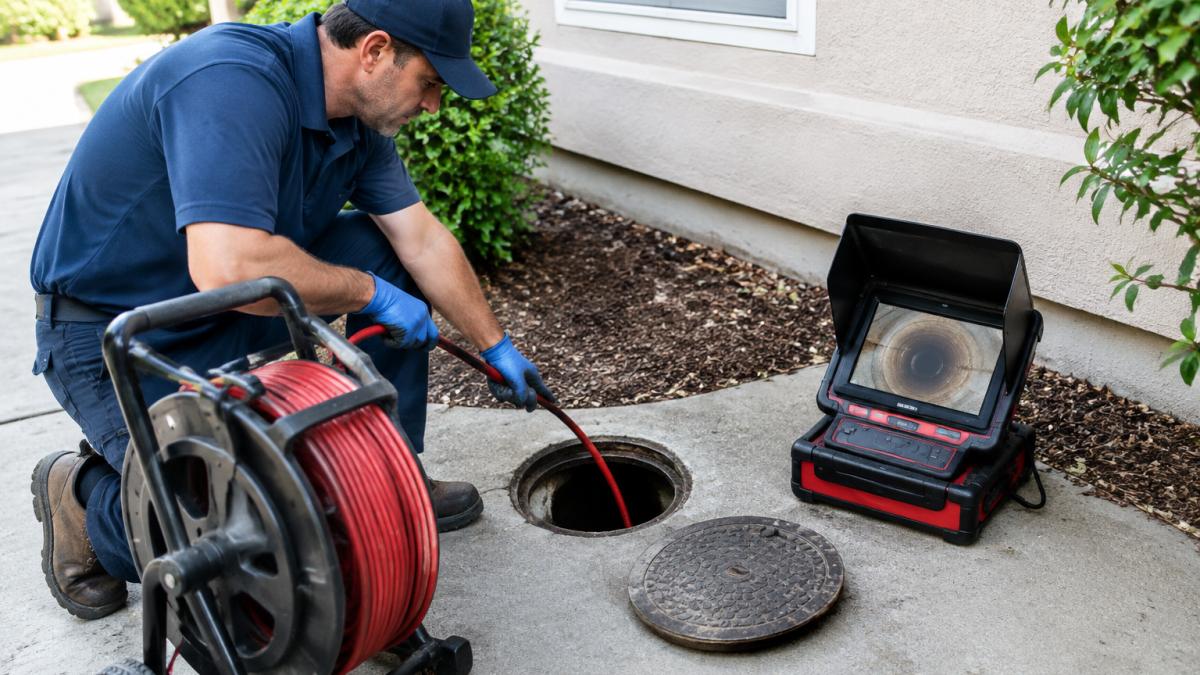
That camera step is where most problems get caught early. If you want to know what that inspection runs, see our breakdown of sewer camera inspection cost before you book.
Main Sewer Line Cleaning Cost: What Drives the Price
Main sewer line cleaning cost depends on the length of the line, the type of blockage, access to the cleanout, and whether jetting or a camera inspection is needed. A simple snake job costs less than a root-clogged line that needs jetting and a follow-up inspection. Pricing depends on the specifics of the job, so an upfront quote is the best way to know the cost before work begins.
What drives the price up:
- Heavy root intrusion that needs repeated passes
- No accessible cleanout, requiring a new one
- Long runs from the house to the street
- Old, fragile pipe that needs a gentler approach
- Emergency or after-hours calls
Snaking vs. Jetting: The Cost Trade-Off
A snake is cheaper per visit, but it punches a hole through the clog and leaves the pipe walls coated. If grease or roots are the cause, the clog returns, and you pay the service call again.
A camera inspection is the third line item, and it is the one that changes the decision. Without it, you are guessing whether the line needs a snake, a jet, or a repair.
What to Ask Before You Approve the Work
- Is the quote flat-rate or hourly, and does it include the camera inspection?
- Is there a charge if the technician cannot reach the blockage?
- Does the price include a post-cleaning camera check to confirm the line is clear?
- Are after-hours and weekend rates different?
Upfront pricing is one of our commitments, so you can review the quote before work begins. If cleaning reveals a cracked or collapsed section, you'll want to see average sewer line repair cost and check whether homeowners insurance covers sewer line repair before deciding on next steps.
Watch out: the lowest advertised cleaning price often covers only a single fixture or a short snake pass, not a main-line jetting with camera verification. Compare quotes on what is included, not on the headline number.
Book a Sewer Line Inspection Before the Next Backup
The homeowners who avoid emergency calls are the ones who schedule inspections before something breaks.
DC Plumbing Heating and Air Conditioning has served South Orange County since 1989 with licensed, certified technicians and upfront pricing. We offer 24/7 emergency service when a backup won't wait.
Don't wait for the gurgle. Get started with DC Plumbing Heating and Air Conditioning and book a sewer line inspection today.
Frequently Asked Questions
How do I keep my sewer line clean between professional cleanings?
Flush only toilet paper and human waste, and keep grease, wipes, coffee grounds, and hair out of drains. Run hot water for 30 seconds after each sink use, and use strainers in tubs and showers. Watch for slow drains or gurgling sounds, which signal buildup before a full blockage forms.
How much does main sewer line cleaning cost?
Main sewer line cleaning cost depends on the clog's location and severity, the cleaning method used, and whether a camera inspection is included. Because pricing varies by job, ask for an upfront quote before work begins.
Can I clean a main sewer line myself?
Hand augers and store-bought drain chemicals reach only the first few feet of a drain and cannot clear a main sewer line blockage. Store chemicals can also damage cast iron and older clay pipes. A main line clog usually needs a professional auger, hydro jetting equipment, or a sewer camera to locate the problem. Attempting it yourself risks damaging the pipe and turning a cleaning job into an emergency repair.
Does every home need routine sewer line cleaning?
No. Homes with newer PVC lines, no large trees near the lateral, and no history of backups can often go years without scheduled cleaning. Older homes with cast iron or clay pipes, mature trees over the line, or a past backup benefit from cleaning every 18 to 24 months, sometimes sooner. A sewer camera inspection tells you what your specific pipe actually needs instead of guessing from a generic timeline.