 how-to
How to Prevent Recurring Sewer Backups: 2026 Guide
Table of Contents
- Why Sewer Backups Keep Coming Back
- Signs of Sewer Line Blockage You Should Never Ignore
- What Not to Flush Down the Toilet (and What to Do Instead)
- Sewer Backwater Valve Installation: Your Best Defense
- Sewer Line Inspection Frequency: How Often Is Enough?
- DIY vs. Professional: When to Call a Plumber
- Seasonal Maintenance Schedule to Prevent Sewer Backups
- Conclusion
- Frequently Asked Questions
Last Updated: October 4, 2026
Why Sewer Backups Keep Coming Back
Recurring sewer backups almost always trace back to one unresolved problem: a blockage or damage that was never fully cleared. A one-time snake job can punch a hole through grease or roots, restore flow for a few weeks, and then fail again. This guide from DC Plumbing Heating and Air Conditioning explains how to prevent recurring sewer backups for good.
Sewer backups are the return of wastewater into your home when the sewer lateral or municipal system can't handle the flow. Most repeat backups share the same causes:
- Tree root intrusion that grows back after partial cutting
- Grease and sludge buildup that re-forms on pipe walls
- Flushable wipes and paper products that snag on rough pipe
Signs of Sewer Line Blockage You Should Never Ignore
The clearest early warning signs of sewer line blockage are slow drains in multiple fixtures, gurgling toilets, and a sewer gas smell near floor drains. Catching these early is far cheaper than waiting for a backup.
- Two or more drains draining slowly at the same time
- Toilets that gurgle or bubble after you run a sink
- Water backing up in a tub when you use the washing machine
One slow drain is usually a local clog; several point to the main line. That distinction decides whether you need a plunger or a plumber.
What Not to Flush Down the Toilet (and What to Do Instead)
Never flush wipes, paper towels, feminine products, cotton swabs, dental floss, or cooking grease. Even "flushable" products don't break down like toilet paper and tangle with roots and grease to form blockages.
Here's a simple rule: if it isn't toilet paper or human waste, it goes in the trash.
| Item | Why It Clogs | Do This Instead |
|---|---|---|
| Flushable wipes | Don't break down; snag on pipe walls | Bag and trash them |
| Cooking grease | Cools and hardens into sludge | Pour into a can, then trash |
| Paper towels | Thicker fibers than toilet paper | Trash or compost |
| Dental floss | Wraps around roots and debris | Trash |
| Coffee grounds | Settle and pack into drains | Compost or trash |
Grease is the biggest offender in kitchen lines: it coats the pipe while warm, then hardens and narrows the line until only a thin channel is left.
Sewer Backwater Valve Installation: Your Best Defense
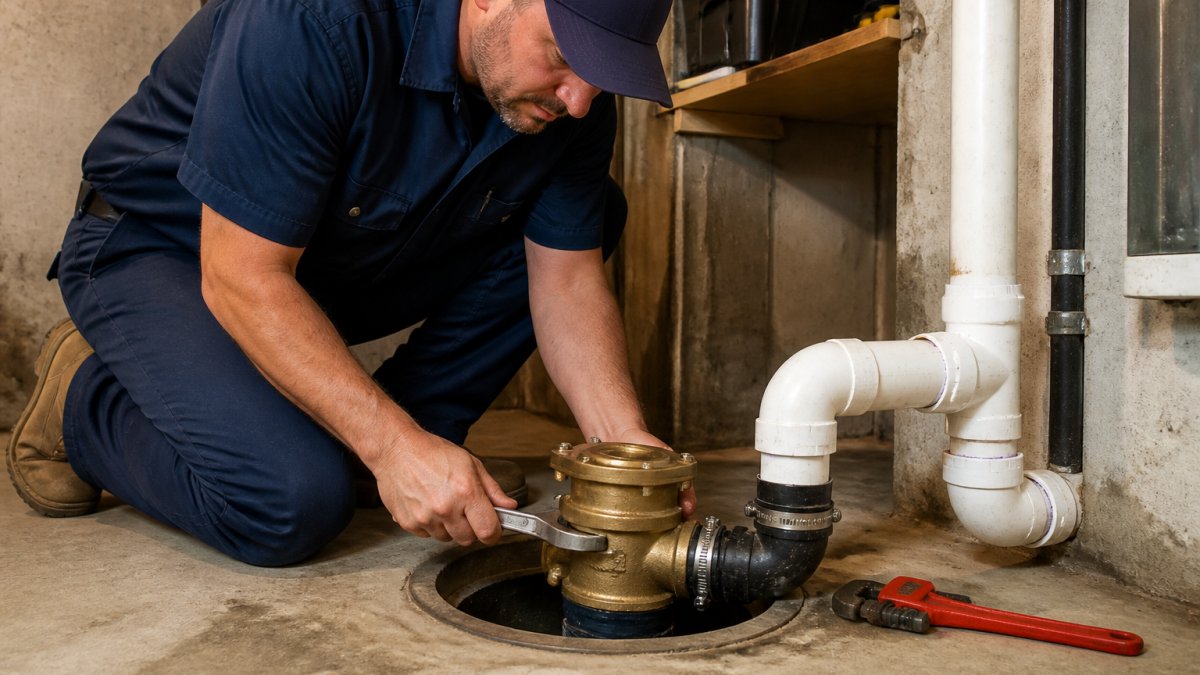
Sewer backwater valve installation is the most effective single protection against sewage backing up into your home. The valve is a one-way gate on the sewer lateral that lets wastewater flow out but closes when flow reverses, blocking municipal surge from your basement or lowest fixtures.
How the valve actually works
Most residential backwater valves use a flapper or float-actuated gate. Under normal flow the flapper hangs open and wastewater passes freely. When the municipal main surcharges, during a heavy storm, combined-sewer overflow, or downstream blockage, reverse flow lifts the float or pushes the flapper, seating the gate against a gasket.
Two designs dominate residential work:
- Normally open: The flapper rests open and only closes on reverse flow. This is the standard choice for most homes because it does not restrict normal drainage.
- Normally closed: The gate stays shut and opens only under forward flow. It offers a stronger seal but can impede drainage if the actuator sticks, and it is usually reserved for specific configurations.
Ask your plumber which design fits your lateral, slope, and municipality before work starts.
Code, permits, and inspection access
Backwater valve requirements are set locally, but most U.S. jurisdictions follow the International Plumbing Code and International Residential Code, which generally require a backwater valve on any fixture or drain below the elevation of the next upstream manhole. Many also require the valve to be accessible for inspection and service, hence the indoor access box rather than a valve buried under a slab.
Before installation:
- Confirm whether your municipality requires a plumbing permit for a lateral backwater valve; many do.
- Ask whether the valve must be a specific type or listing (for example, a listed backwater valve with a removable cover).
- Confirm the inspection sequence, most jurisdictions want the valve visible and the line flow-tested before the access cover goes back on.
Skipping the permit can complicate a home sale, insurance claim, or future repair.
The installation sequence
- A technician locates the sewer cleanout and main line.
- The line is inspected with a sewer camera to confirm placement, slope, and condition.
- The valve is fitted into the lateral, either at the cleanout or a new access point.
- The connection is sealed and tested for water flow and backflow.
- A cleanout cap or access cover is reinstalled for future service.
Why valves fail to stop repeat backups
A backwater valve is not maintenance-free. The most common reasons a properly installed valve still lets water in:
- Debris on the seat: Grease, wipes, or roots prevent the flapper from sealing. This is the number-one cause of valve failure.
- No service access: A valve buried without a removable cover cannot be cleaned, so it degrades silently.
- Wrong orientation or slope: A valve installed against the flow direction or on a flat section may not seat correctly.
Have the valve cleaned during your regular plumbing inspection and after any significant backup event so debris does not jam the flapper.
What it costs and what it saves
Installation cost varies with access, pipe material, and whether a new cleanout or access box is needed. A single finished-basement sewage backup can run into significant costs for remediation and contents.
Sewer Line Inspection Frequency: How Often Is Enough?
Sewer line inspection frequency depends on your home's age, tree cover, and history. Most homes need a professional inspection every 18 to 24 months; homes with large trees near the lateral, older clay or cast-iron pipes, or a past backup should be inspected every 12 months.
A plumbing inspection uses a sewer camera to look inside the pipe, revealing root intrusion, cracks, offsets, collapsed sections, grease and scale buildup, and bellies where waste pools.
DIY vs. Professional: When to Call a Plumber
Most guides say "call a professional if it's serious" without defining serious, so homeowners either waste money on a plumber for a single slow sink or run a rented auger through a main line and crack a clay pipe. Here is a framework you can apply.
The three-question test
Before you touch a drain, answer three questions:
- How many fixtures are affected? One fixture points to a local clog. Two or more on the same floor, or any backup in a floor drain or tub, points to the main line.
- Does the clog return? A clog that comes back within a few weeks was never fully cleared, a main-line symptom.
- Is there any sign of pipe damage? Sewer gas odor, soggy ground over the lateral, or a sinkhole in the yard means the pipe itself is compromised. Stop and call.
If you answer "one fixture, first time, no damage signs," DIY is reasonable. Any other combination, call a licensed plumber.
What you can safely do yourself
- Boiling water and a plunger for a single slow sink or tub. Safe on most drain lines and costs nothing.
- A hand snake (drain auger) for a single clogged sink or tub drain. Keep it under 25 feet and stop if you feel hard resistance, often a pipe fitting or a root, not a clog.
- Removing and cleaning a sink P-trap. The most common local clog location, and a 15-minute job with a bucket and channel-lock pliers.
What you should never DIY on a main line
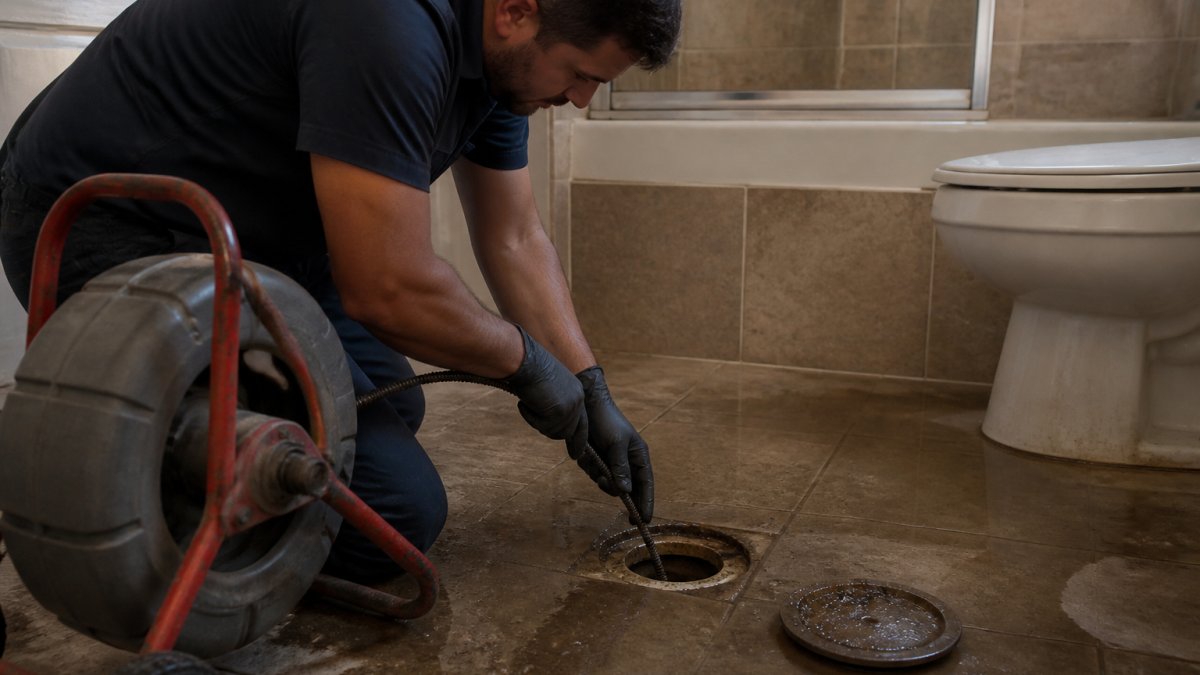
- Rented drum augers (rooters). Powerful enough to crack clay tile, shear off cast-iron, or wrap around a root ball and bind. A cracked lateral is a five-figure repair; professional drain cleaning is a few hundred dollars.
- Chemical drain cleaners on a main line. Caustic and acid cleaners can damage older pipes and rarely clear a root or grease blockage, they just punch a channel that closes again.
- Hydro-jetting. Requires specialized equipment and pressure control; done wrong, it can blow out a weak pipe joint.
The cost-of-mistake math
A cracked or collapsed lateral repair, a common outcome of an aggressive DIY rooter job, can be costly, plus yard restoration. The math favors calling a professional when the main line is involved.
When to call immediately (not next week)
- Backup in more than one fixture
- Sewer gas odor anywhere in the home
- Water rising in a floor drain or tub
Hydro-jetting and pipe lining: what the pros actually do
Hydro-jetting scours grease and roots from the full pipe wall with high-pressure water and is the standard follow-up to a camera inspection that finds heavy buildup. Pipe lining (cured-in-place pipe, or CIPP) repairs cracks and root entry points from the inside without digging up your yard. Both require training, equipment, and often a permit, neither is a homeowner tool.
Seasonal Maintenance Schedule to Prevent Sewer Backups
A seasonal routine prevents most recurring sewer backups. Match each task to the season and its weather risks.
- Spring: Clear gutters and downspouts; check the sump pump
- Spring: Schedule a sewer camera inspection if it's been 12+ months
- Summer: Watch for slow drains after heavy rain
Septic owners should have the tank pumped on the schedule their provider recommends, never treat it like a municipal sewer system.
Conclusion
Recurring backups are a symptom, not a sentence. Fix the cause, add a backwater valve, and keep a maintenance schedule, and the cycle stops.
DC Plumbing Heating and Air Conditioning has served the area since 1989 with licensed, certified technicians and upfront pricing with no surprise fees. We offer 24/7 emergency service, warranty-backed workmanship, and expert guidance so you can make informed decisions about your sewer line.
Frequently Asked Questions
Why does sewage back up into my basement?
Sewage backs up when the municipal sewer main or your private sewer lateral becomes blocked or overwhelmed. Common causes include tree root intrusion, grease buildup, flushed wipes, and aging pipes that have shifted or cracked. When wastewater cannot flow away from your home, it reverses direction and exits through the lowest drain, usually a basement floor drain. A backwater valve installed on the sewer lateral prevents this reversal by blocking flow from the city side.
Can the city be held liable for a sewage backup in my home?
Liability depends on local laws and whether the city failed to maintain the municipal sewer system. Most municipalities are not automatically responsible for backups caused by blockages on your private lateral. To pursue a claim, you typically need documentation showing the city knew about a problem and did not act. Check your homeowner insurance policy and consult a local attorney familiar with municipal liability rules in your area.
Is sewer backup insurance coverage worth the cost?
For homeowners in areas with mature trees or older sewer laterals, sewer backup coverage is often worth adding. Standard homeowner policies usually exclude sewer backups unless you purchase an endorsement. The coverage typically pays for cleanup, damaged belongings, and temporary lodging. Compare the annual premium against the cost of a single backup cleanup, which can run into thousands of dollars, and decide based on your risk factors.
How often should I have my sewer lines professionally inspected?
Most plumbing professionals recommend a sewer line inspection every 18 to 24 months for homes with mature trees or known root intrusion history. If your home is newer or has no tree issues, every two to three years is reasonable. A camera inspection, also called a sewer scope, identifies cracks, root infiltration, and buildup before they cause a backup. After any prior backup, schedule an inspection within 30 days.