 ultimate-guide
Tankless Water Heater Upgrade: A Complete 2026 Guide
Table of Contents
- Why Homeowners Are Upgrading to Tankless Water Heaters
- Endless Hot Water Supply and On-Demand Heating
- Energy Efficiency and Monthly Utility Savings
- Space-Saving Design and Compact Footprint
- Tankless Water Heater Pros and Cons
- Tankless Water Heater vs. Tank Water Heater: What's the Real Difference
- Tankless Water Heater Sizing and Flow Rate Requirements
- Tankless Water Heater Installation Cost and ROI Payback Period
- Frequently Asked Questions
Last Updated: October 5, 2026
Why Homeowners Are Upgrading to Tankless Water Heaters
A tankless water heater upgrade is one of the most practical investments a homeowner can make for long-term comfort and efficiency.
This guide covers what actually changes when you upgrade, how the economics work out, and whether the investment makes sense for your household.
Most homeowners don't realize how much energy a traditional water heater wastes.
The decision isn't just about comfort, it's about understanding your hot water demand, calculating ROI, and ensuring proper sizing so the system performs as expected.
Endless Hot Water Supply and On-Demand Heating
On-demand water heating delivers hot water without the limitations of a storage tank.
A traditional tank holds a fixed 40 to 80 gallons. Once depleted, you wait for it to reheat.
The benefit is obvious during peak demand: morning routines with back-to-back showers no longer leave the last person with cold water, which alone justifies the upgrade for larger households.
One important limitation: flow rate matters. A tankless system has a maximum flow capacity, measured in gallons per minute (GPM).
Energy Efficiency and Monthly Utility Savings
Energy efficiency is the primary financial driver behind most tankless upgrades. Traditional water heaters consume energy continuously to maintain temperature; tankless systems eliminate that standby loss entirely.
The difference shows on your utility bill: modern tankless units reach 80-99% thermal efficiency, compared to 50-70% for conventional tanks, because they only activate when hot water is needed.
Actual savings depend on your energy source, usage patterns, and local rates.
Gas-powered tankless systems offer faster temperature rise and lower operating costs than electric models, especially where natural gas is cheap.
Space-Saving Design and Compact Footprint
Traditional water heaters demand significant space.
Tankless units mount directly to walls and measure roughly 24 by 18 by 10 inches.
The compact design also simplifies installation: a wall-mounted unit requires less structural work than replacing a large tank, and condensing tankless heaters can vent through standard PVC pipe rather than rigid metal ducting.
Freeing up utility closet space also means easier access to other systems, better airflow for HVAC equipment, and a cleaner aesthetic than the industrial bulk of a traditional tank.
Tankless Water Heater Pros and Cons
Key Advantages
A tankless water heater upgrade delivers concrete benefits that justify the higher upfront investment for most households.
Space savings free up valuable real estate, as wall-mounted installation reclaims utility closet or basement space.
Reduced water damage risk protects your home, since tankless systems have no large water volume to rupture and flood a basement.
Lower carbon footprint appeals to environmentally conscious homeowners, as reduced energy consumption means lower greenhouse gas emissions over the system's lifetime.
Important Limitations
Understanding the drawbacks helps you decide whether a tankless water heater upgrade aligns with your situation.
Installation complexity can be substantial, as venting, gas line upgrades, or electrical expansion may add thousands.
Water quality affects some installations: hard water causes scale buildup inside the heat exchanger, requiring more frequent professional descaling.
Cold water sandwich effect occurs with some models, a brief surge of cold water when the system activates after non-use.
Tankless Water Heater vs. Tank Water Heater: What's the Real Difference
How Each System Works
A traditional tank water heater stores 40-80 gallons in an insulated tank, with a gas burner or electric element maintaining temperature continuously.
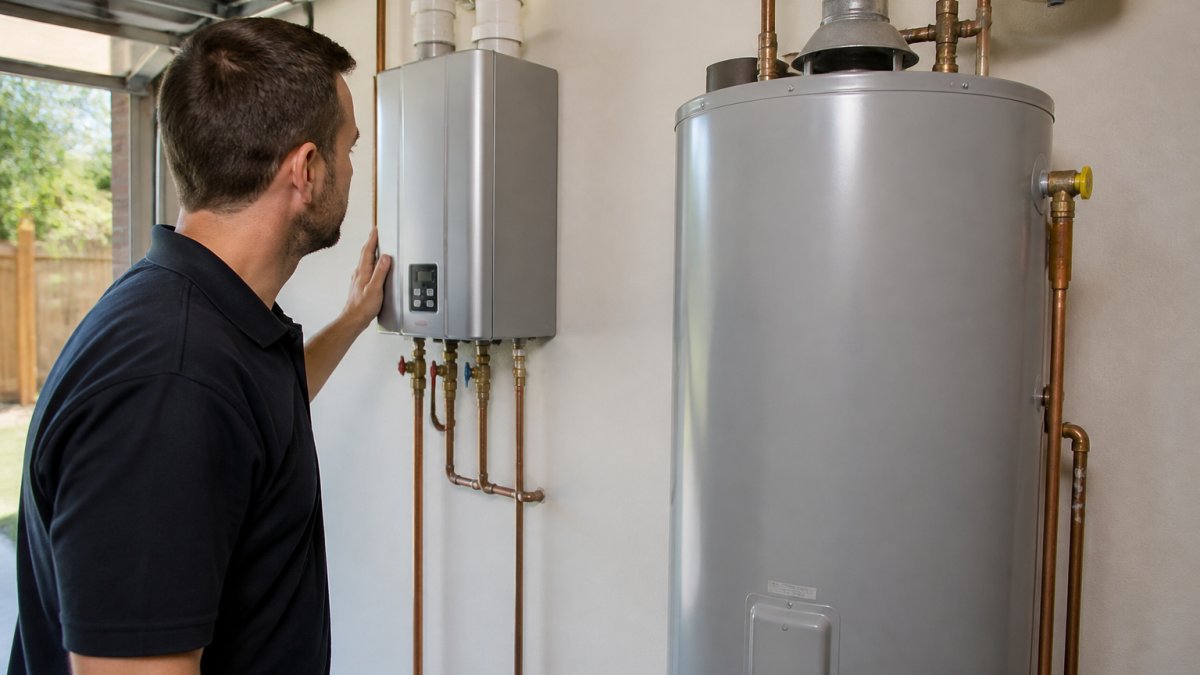
A tankless system has no storage.
This operational difference explains the efficiency gap: a tank loses heat continuously to its surroundings, a process called standby loss, which tankless systems eliminate entirely.
(https://blog.dcplumbing.net/residential-plumbing-maintenance-checklist-2026).The durability difference affects long-term economics: fewer replacement cycles and lower cumulative costs over 30-40 years, strengthening the financial case if you plan to stay a decade or more.
Maintenance and Descaling Requirements
Traditional tanks require minimal routine maintenance: an annual flush to remove sediment and anode rod replacement every 3-5 years, then largely maintenance-free operation until failure.
Tankless systems demand more active maintenance, particularly in hard water areas, where mineral scale accumulates inside the heat exchanger and reduces efficiency.
This isn't a deal-breaker, but neglecting descaling in hard water regions means declining performance and potential failure. Regular maintenance extends lifespan and preserves efficiency.
Tankless Water Heater Sizing and Flow Rate Requirements
Calculating Your Household Demand
Proper sizing determines whether a tankless water heater upgrade delivers the endless hot water you expect. Undersizing disappoints; oversizing wastes money.
Start by identifying your peak hot water demand, the moment when the most hot water flows simultaneously, usually during morning routines or when someone showers while hot laundry runs.
Calculate flow rate by adding the GPM of simultaneous fixtures:
- Shower: 2-2.5 GPM
- Bathroom sink: 0.5-1 GPM
- Kitchen sink: 1-1.5 GPM
Most whole-home tankless systems deliver 5-8 GPM, covering typical demand; larger families or homes with high simultaneous usage may need 10+ GPM.
Temperature Rise and BTU Rating
Temperature rise, the difference between incoming cold water and desired hot water temperature, determines the BTU capacity your system needs.
Cold water temperature varies seasonally: incoming water might be 40°F in winter and 60°F in summer, while most people prefer around 110°F for showering, a 50-70°F rise.
Sizing combines flow rate and temperature rise requirements. A professional assessment determines the exact BTU capacity you need; undersizing disappoints and oversizing adds cost.
Tankless Water Heater Installation Cost and ROI Payback Period
Understanding Upfront Investment
Installation costs for a tankless water heater upgrade depend on existing infrastructure and system complexity.
A tankless replacement costs more than tank replacement alone, with the specific cost depending on venting, gas line upgrades, electrical capacity, and local labor rates.
DC Plumbing Heating and Air Conditioning provides transparent upfront pricing without surprise fees. Our licensed technicians evaluate your existing setup and deliver a clear estimate before any work begins.
Tax Credits and Rebate Opportunities
Federal energy efficiency tax credits reduce the effective cost of tankless upgrades. The Energy Policy Act lets homeowners claim credits for qualified energy-efficient water heaters and related installation costs, lowering your net investment.
Many state and local utilities offer rebates for Energy Star-certified tankless systems, typically $100 to several hundred dollars, further reducing your effective upfront cost.
Check with your local utility and the Database of State Incentives for Renewables and Efficiency (DSIRE) for current programs.
Calculating Your Break-Even Timeline
The payback period, how long until energy savings cover the upfront investment, varies with energy costs, hot water usage, system efficiency, and installation cost.
High consumption and favorable energy rates might mean break-even in 5-7 years; moderate usage and higher installation costs might need 8-10 years.
Over a 15-20 year lifespan, cumulative energy savings, combined with comfort and space savings, can justify the upgrade for many homeowners planning to stay.
| Factor | Impact on Payback Timeline |
|---|---|
| High household water usage | Faster payback (5-7 years) |
| Moderate household water usage | Standard payback (7-10 years) |
| Low household water usage | Slower payback (10+ years) |
| High energy rates | Faster payback |
| Low energy rates | Slower payback |
| Federal tax credits + rebates | Reduces effective cost, accelerates payback |
| High installation cost | Extends payback timeline |
| Low installation cost | Accelerates payback |
Frequently Asked Questions
Is it worth upgrading to a tankless water heater?
Whether an upgrade makes sense depends on your hot water usage patterns and budget. Tankless systems deliver endless hot water on-demand and reduce standby energy loss, which can lower utility bills for households with moderate to high hot water demand. However, the upfront cost is higher than traditional tank models. Homes with consistent daily hot water needs typically see a payback period of 5-12 years through energy savings, making the long-term ROI attractive. Consult with a licensed technician to assess your household's specific flow rate needs and calculate your expected savings.
What size tankless water heater do I need for my home?
Sizing depends on two factors: your peak hot water demand (measured in gallons per minute) and the temperature rise required. A 2000 sq ft home with 2-3 bathrooms typically needs a system rated for 6-8 gallons per minute. If you want simultaneous hot water in multiple fixtures, you may need a higher capacity unit or a whole-home system. Professional sizing also accounts for your incoming water temperature and desired output temperature. An undersized unit will struggle during peak demand; an oversized unit wastes money upfront. A licensed technician can evaluate your home's layout and usage patterns to recommend the correct BTU rating and flow rate.
What is the downside of a tankless water heater?
Common drawbacks include higher installation costs, scale buildup requiring regular descaling maintenance, and potential water pressure drops if multiple fixtures run simultaneously. Gas-powered models require proper venting, which may involve retrofit work in older homes. Some users experience a slight delay before hot water reaches distant fixtures (cold water sandwich effect). Tankless systems also perform less efficiently in very cold climates where temperature rise is greatest. Additionally, if your home's electrical or gas infrastructure is outdated, upgrades may be necessary before installation, adding to the overall cost.
How much does a tankless water heater increase your electric bill?
Electric tankless water heaters typically increase your electric bill by 5-15% depending on usage, compared to traditional tank models that maintain constant standby energy loss. However, tankless systems are more efficient overall because they only heat water when you need it, eliminating the energy waste of keeping a full tank hot 24/7. Natural gas tankless units have lower operating costs than electric models. Your actual savings depend on your household's hot water demand, local utility rates, and how efficiently your previous system operated. Professional installation and proper sizing ensure optimal thermal efficiency and minimize wasted energy.
Does a tankless water heater provide unlimited hot water?
Tankless systems provide continuous hot water for as long as you need it, but they are not truly unlimited. They are constrained by their flow rate (measured in gallons per minute) and the temperature rise they can achieve. If you exceed the unit's flow rate capacity, water temperature will drop. For example, if your system is rated for 7 gallons per minute and you run two showers simultaneously, you may not have enough hot water at full temperature for both. Proper sizing ensures the system meets your peak demand. Most households find that a correctly sized tankless unit provides more than adequate hot water for daily use.
How long does a tankless water heater last?
Tankless water heaters typically last 15-20 years with proper maintenance, significantly longer than traditional tank models which last 8-12 years. Regular descaling to prevent scale buildup and annual professional inspections extend lifespan considerably. Hard water areas may require more frequent maintenance. Most manufacturers offer warranties covering parts for 5-15 years, depending on the model. The longer lifespan, combined with lower operating costs, contributes to the overall return on investment. Licensed technicians can assess your water quality and recommend a maintenance schedule to maximize durability.
What tax credits or rebates are available for tankless water heater upgrades?
Federal tax credits and rebates vary by year and energy efficiency ratings. The Inflation Reduction Act offers tax credits for qualifying Energy Star-rated water heaters, though specific incentives change annually. Many states and local utilities also provide rebate programs to encourage energy-efficient upgrades. Eligibility typically requires installation by a licensed professional and meeting minimum efficiency standards. Check your state's energy office website and local utility company for current programs in your area. A qualified technician can help verify which incentives apply to your situation and ensure your system qualifies for all available credits.