 Ultimate guide
Commercial HVAC Maintenance for Property Managers
Table of Contents
- What Commercial HVAC Maintenance Includes
- Building a Commercial HVAC Preventive Maintenance Checklist
- Establishing a Commercial HVAC Maintenance Schedule
- Using a Commercial HVAC Maintenance Log Template
- Selecting and Managing a Commercial HVAC Service Contract
- Reducing Operating Costs and Extending Equipment Lifespan
- Portfolio-Level Planning and Compliance Documentation
- Frequently Asked Questions
Last Updated: October 17, 2026
What Commercial HVAC Maintenance Includes
Commercial HVAC maintenance for property managers covers preventive and corrective tasks that keep heating, cooling, and ventilation systems efficient.
At DC Plumbing Heating and Air Conditioning, we've worked with property managers across South Orange County to develop maintenance approaches for commercial properties.
The core principle: planned maintenance prevents unplanned downtime. A rooftop unit receiving quarterly attention performs reliably for years; a neglected one fails during peak demand, usually on a weekend or holiday when emergency service costs triple.
Building a Commercial HVAC Preventive Maintenance Checklist
A solid preventive maintenance checklist is your operational blueprint, ensuring nothing is overlooked and giving your provider clear expectations for each visit.
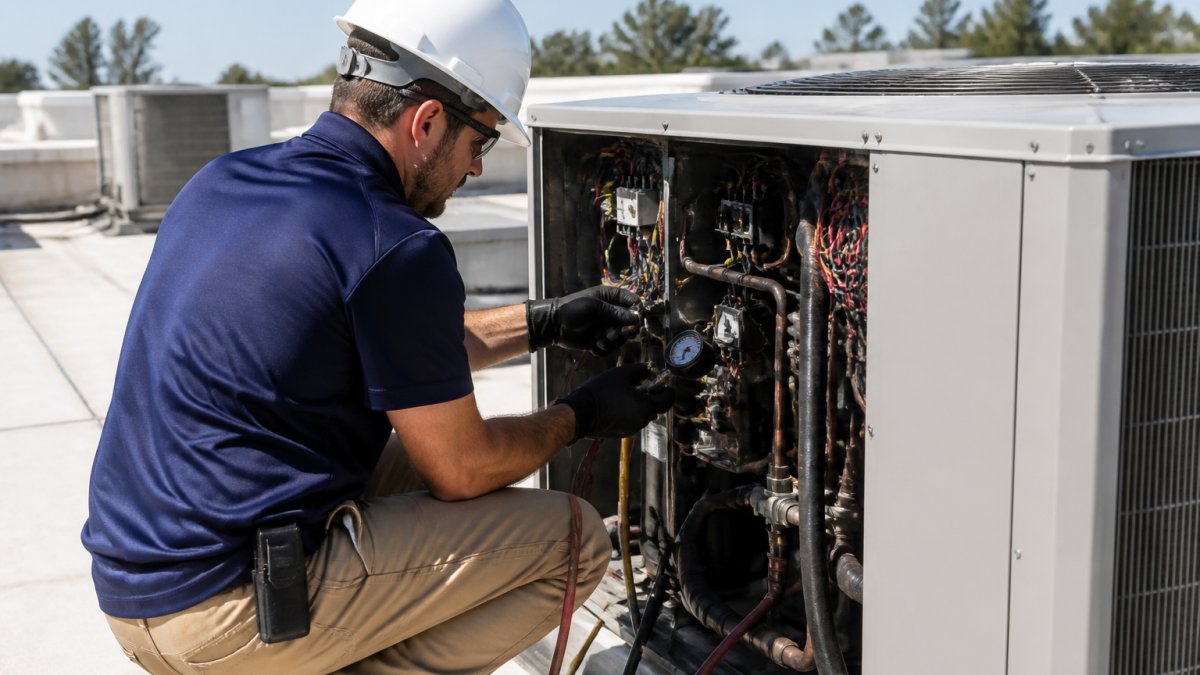
Organize your checklist by frequency: quarterly tasks, seasonal inspections, and annual deep dives. Basics include filter condition and replacement, condenser coil inspection, blower operation, and thermostat verification.
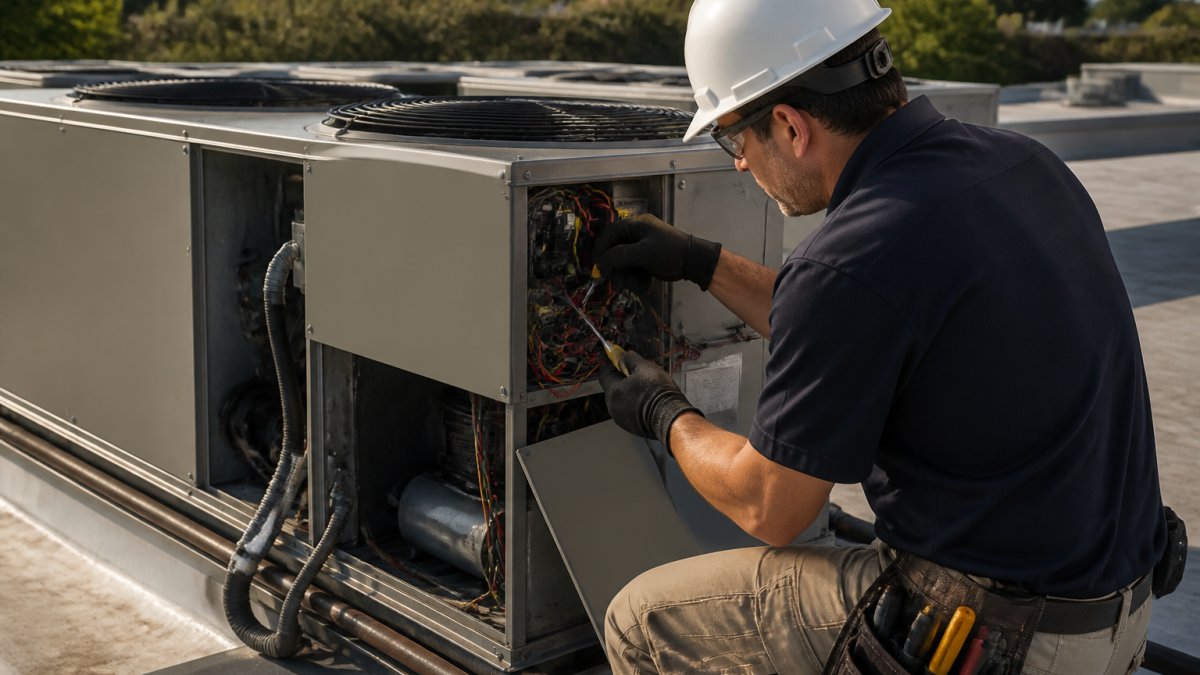
For rooftop units, include mounting hardware, weatherproofing seals, and drainage pathways. Document system age and manufacturer-recommended service intervals.
Quarterly and Seasonal Tasks
Quarterly maintenance keeps systems responsive. In spring, before cooling season, inspect condenser coils, verify refrigerant levels, test electrical connections for corrosion or looseness, and confirm thermostat calibration. Summer checks focus on airflow, ensuring blower motors run smoothly and no blockages restrict distribution.
Fall prep covers heating equipment, boiler or furnace components, and controls ready to switch modes. Winter checks confirm heating output and flag unusual sounds or performance drops signaling wear.
Annual Deep Inspections
Once yearly, conduct a thorough assessment: professional coil cleaning (evaporator and condenser coils accumulate debris that reduces efficiency), electrical inspection with load testing, refrigerant pressure and superheat verification, compressor assessment, and bearing lubrication.
Document everything: photograph equipment condition, record measurements and test results, note worn components, and flag anything nearing end of service life. This documentation is invaluable for planning replacements and demonstrating responsible maintenance to auditors or regulators.
Establishing a Commercial HVAC Maintenance Schedule
A written maintenance schedule defends against reactive, expensive repairs. Most commercial properties benefit from quarterly service visits, one per season, plus monthly filter checks staff can perform without specialized equipment.
Align the schedule with occupancy patterns and climate demands. A 24/7 data center might need monthly full inspections; a seasonal office can compress maintenance into spring and fall windows.
Using a Commercial HVAC Maintenance Log Template
Consistent documentation turns maintenance into data-driven management. A commercial HVAC maintenance log template should capture service date, technician name and credentials, tasks completed, measurements (filter condition, refrigerant pressure, voltage), parts replaced, labor hours, and future recommendations.
Digital logs beat paper: searchable, auto-timestamped, able to flag overdue service, and integrable with budgeting systems. Some property management software includes HVAC logging; otherwise a shared spreadsheet with date, equipment ID, service type, and notes works well.
Selecting and Managing a Commercial HVAC Service Contract
Your service contract defines expectations, pricing, response times, and warranty coverage. Most property managers compare on price alone, the fastest way to buy the wrong coverage. Compare total cost of ownership across the term, not the monthly line item.
Build a side-by-side comparison before you sign
Ask every candidate provider to quote against the same written scope so the numbers are comparable. A practical comparison sheet has these rows:
- Equipment covered, list every rooftop unit, air handler, boiler, and control by asset ID. Confirm whether the quote covers all of them or only "major equipment."
- Tasks per visit, filter change, coil cleaning, refrigerant pressure check, electrical torque check, belt and bearing inspection, condensate drain clearing, control calibration. Mark each as included, optional, or excluded.
- Visit frequency and seasonality, quarterly, semi-annual, or custom. Confirm spring cooling prep and fall heating prep are separate visits, not combined.
Read the exclusions as carefully as the inclusions
A common pattern is a low base fee paired with broad exclusions. If compressors, motors, and refrigerant are excluded, the contract covers labor and minor parts but leaves the largest failure costs with you. That is not necessarily wrong, it can be the right structure for an older portfolio, but you need to price the exposure. Ask each provider for a sample invoice showing how a compressor replacement and a refrigerant leak would be billed under their agreement.
Match response-time tiers to asset criticality
Not every building needs the same response. A medical tenant, a data closet, or a refrigerated space justifies a priority or emergency tier. A storage building or a seasonal office may be fine with next-business-day response. Buy the tier per asset, not per portfolio, and put the tier in the contract so dispatch knows which clock applies.
Price the contract against lifecycle cost
Compare the annual contract price to expected reactive repair costs. A preventive agreement typically costs a fraction of the emergency and overtime spend it displaces, though the ratio depends on equipment age and condition. Build a three-year model: contract fees plus expected excluded repairs plus a reserve for one major failure, versus run-to-failure with higher emergency labor, overtime, and shortened asset life.
Manage the contract after signature
- Hold a kickoff walk-through and tag every asset with an ID that matches the contract schedule.
- Require a report after every visit with tasks completed, readings recorded, and recommendations.
- Review the report monthly and track completion against the contracted task list.
ENERGY STAR building upgrade guidance
DC Plumbing Heating and Air Conditioning brings nearly 38 years of experience serving commercial clients across South Orange County. Our licensed and certified technicians understand the demands of managing multiple properties and the importance of predictable service and transparent pricing. We provide detailed maintenance reporting and work with you to design service schedules that match your building's specific needs.
Reducing Operating Costs and Extending Equipment Lifespan
Well-maintained HVAC systems run more efficiently and last longer, delivering consistent performance and predictable operating costs. Deferred maintenance raises energy consumption: dirty coils force compressors to work harder, loose connections reduce efficiency, and worn bearings increase friction.
Planned maintenance typically costs 10-20% of emergency repair costs.
Preventive care measurably extends equipment lifespan. A commercial rooftop unit typically lasts 15-20 years with proper maintenance; without it, expect failure by year 10-12, a difference that translates directly to avoided replacement capital expenses and continued reliability.
Track maintenance spending alongside energy bills. Well-maintained systems show lower consumption and stable monthly costs; unexpected spikes often signal degraded efficiency and overdue maintenance.
Portfolio-Level Planning and Compliance Documentation
For property managers overseeing multiple buildings, portfolio-level HVAC planning is essential: spend maintenance and capital budgets where failure would hurt most, and prove what you did. Two disciplines make that possible, a prioritization method and an audit-ready record system.
Prioritize work by criticality, condition, and risk
Score every asset on three factors and use the total to sequence work and capital:
- Criticality, what happens if it fails? Tenant health and safety, revenue loss, lease obligations, and irreplaceable equipment rank highest. Storage and low-occupancy space rank lowest.
- Condition, age relative to expected service life, repair history, and the technician's condition rating from the last inspection. A rooftop unit at year 14 of a 15-20 year expected life is a different risk than one at year 4.
- Risk exposure, likelihood of failure multiplied by the cost of downtime. A unit serving a single tenant with a backup is lower risk than a single point of failure serving multiple tenants.
A simple 1-5 score on each factor produces a ranked list. Fund preventive work and capital replacement from the top down. This is also how you defend a capital request to an owner: the score shows why this unit and not another.
Stagger the calendar across the portfolio
Build a master calendar spreading service visits across the year so you don't absorb multiple emergency calls or capital hits in one quarter. Group equipment by age and expected service life so replacements land in planned budget years. Where a provider serves several buildings, negotiate route pricing, combining visits on one trip usually lowers per-visit cost.
Track a small set of KPIs
You cannot manage what you do not measure. A practical dashboard for a property manager includes:
- PM completion rate, scheduled preventive visits completed on time versus scheduled.
- Work-order response time, average and worst-case time from call to arrival, by tier.
- Repeat failures, same asset, same failure mode within a defined window (for example, 90 days).
Review these monthly with the service provider and quarterly with ownership. They turn maintenance from a cost line into a managed program.
Keep audit-ready documentation
Maintain centralized records for every asset: specifications, install date, service history, refrigerant log, warranty documents, and the current contract. Organize by asset ID so a single search returns the full history.
Refrigerant records deserve special attention. Under federal refrigerant management rules, owners and operators of certain equipment must keep service and refrigerant records, and technicians must be certified to handle regulated refrigerants (the EPA).
Connect documentation to tenant comfort
Log every comfort complaint against the asset and zone serving it. Triage by pattern: a single complaint may be a setpoint issue, but recurring complaints in one zone usually point to airflow balance, control calibration, or an undersized unit.
Some jurisdictions require HVAC documentation for building permits, energy benchmarking, or lease compliance. Ready access to comprehensive maintenance records accelerates those processes and protects you from liability claims.
Frequently Asked Questions
What does preventive maintenance on a commercial HVAC system include?
Preventive commercial HVAC maintenance covers air filter inspection and replacement, coil cleaning, airflow checks, thermostat calibration, refrigerant level verification, electrical connection inspection, blower component assessment, and rooftop unit examination. Property managers should also verify system pressure, test controls, and document all findings. Regular preventive maintenance reduces breakdown risk, extends equipment lifespan, and maintains energy efficiency across your commercial properties.
How often should commercial HVAC systems be serviced?
Commercial HVAC systems typically need quarterly maintenance visits plus seasonal pre-cooling and pre-heating checks. Most facilities benefit from spring and fall seasonal service before peak demand periods. The exact frequency depends on equipment age, building size, usage patterns, and local climate. Your commercial HVAC service contract should specify maintenance frequency. More frequent service intervals apply to older equipment or high-use commercial properties. Document all service dates in your maintenance log template.
What should a commercial HVAC maintenance log template track?
A commercial HVAC maintenance log template should record the service date, technician name, equipment inspected, tasks completed, parts replaced, refrigerant levels, system pressure readings, thermostat calibration results, any repairs needed, and next scheduled service date. Include columns for filter replacement, coil cleaning confirmation, airflow measurements, and cost. Property managers overseeing multiple commercial properties benefit from a centralized log that tracks performance trends, identifies recurring issues, and supports warranty claims and compliance documentation.
What should property managers include in a commercial HVAC service contract?
A commercial HVAC service contract should specify maintenance frequency, response time for emergency repairs, parts and labor coverage, warranty terms, and pricing structure. Include clauses for seasonal service, filter replacement, coil cleaning, thermostat calibration, and detailed reporting. Define whether the contract covers rooftop units, ductwork inspection, and building controls adjustment. Require the vendor to provide a maintenance schedule and log template. Clarify emergency response availability and whether service is available 24/7 for critical breakdowns that affect tenant comfort or building operations.
How can property managers reduce commercial HVAC operating costs?
Reduce operating costs through consistent preventive maintenance, which improves energy efficiency and prevents costly breakdowns. Clean coils and replace air filters on schedule to maintain airflow and system performance. Calibrate thermostats to optimize heating and cooling cycles. Inspect ductwork for leaks that waste conditioned air. Schedule seasonal adjustments before peak demand periods. Monitor energy usage trends in your maintenance log to identify underperforming equipment. Preventive maintenance typically costs less than emergency repairs and extends equipment lifespan, lowering replacement expenses.
What signs indicate a commercial HVAC system needs repair?
Watch for uneven climate control across zones, weak airflow, unusual noises from rooftop units or ductwork, refrigerant leaks, thermostat calibration drift, or higher-than-normal energy bills. Tenant complaints about comfort levels signal potential airflow or control issues. Rising operating costs despite regular maintenance may indicate worn blower components or compressor problems. Document these warning signs in your maintenance log and contact your HVAC vendor promptly. Early detection prevents emergency breakdowns and minimizes tenant disruption.
How long does a commercial HVAC unit typically last?
Well-maintained commercial HVAC equipment typically lasts 15 to 20 years, though lifespan depends on usage, maintenance frequency, and climate. Preventive maintenance extends equipment life by reducing wear on compressors, blowers, and controls. Your maintenance log should track age and performance trends to support replacement decisions. When repair costs exceed 50% of replacement cost annually, upgrading may be more economical. Plan capital budgets around expected equipment lifespan and schedule replacements during off-peak seasons to minimize tenant disruption.
ASHRAE guidelines for commercial HVAC maintenance
EPA guidance on refrigerant handling and system maintenance
HVAC equipment manufacturer maintenance recommendations