 ultimate-guide
Best Tankless Water Heater Installation Tips
Table of Contents
- Gas Line Sizing for Tankless Water Heaters
- Tankless Water Heater Venting Best Practices
- Tankless Water Heater Permit Requirements
- Professional Tankless Water Heater Installation Cost
- Common Tankless Water Heater Installation Mistakes to Avoid
- Troubleshooting a New Tankless Water Heater
- Frequently Asked Questions
Last Updated: September 25, 2026
Gas Line Sizing for Tankless Water Heaters
The best tankless water heater installation tips start with one number: BTU load. A tankless unit fires far harder than the tank it replaces, and the gas line feeding it must match that demand.
Gas line sizing for tankless water heaters is the process of matching pipe diameter and length to the unit's BTU input so the burner receives enough volume at stable pressure. Undersize the line and the heater short-cycles, throws error codes, or never reaches full output.
Most tank-style heaters draw a modest, steady flame. A tankless unit can pull three to five times that load the moment a hot tap opens. That difference is why so many installs that "should work" fail inspection or underperform.
If you want the sizing verified rather than guessed, DC Plumbing Heating and Air Conditioning handles gas line work for residential clients across South Orange County.
Why BTU Load Decides Your Gas Line Size
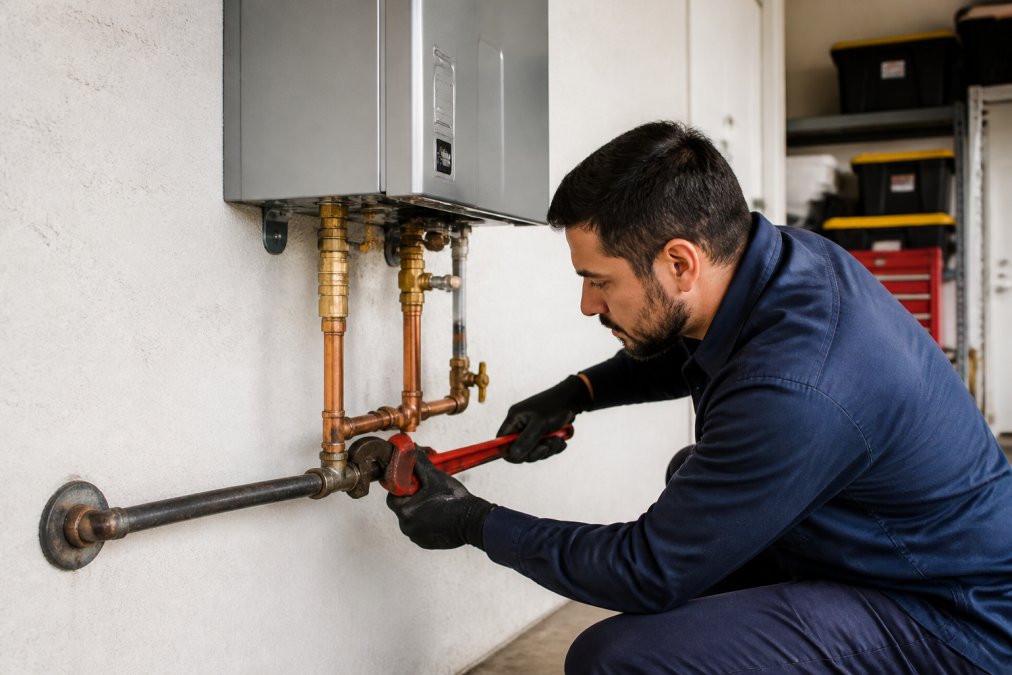
Pipe diameter, run length, and total connected load set how much gas reaches the unit. A short run of wider pipe carries more volume than a long run of narrow pipe, and every elbow, tee, and reducer adds resistance.
A common mistake is reusing the old tank heater's gas stub without checking capacity. The old line may have fed a 40,000 BTU tank unit; the new tankless model can demand well over 150,000 BTU. Contractors size gas lines against the appliance's rated input, not the pipe that happens to be in the wall.
Signs Your Existing Gas Line Is Undersized
Watch for these symptoms after installation:
- The unit ignites, then shuts off within seconds
- Error codes related to flame or gas supply appear
- Hot water temperature fluctuates when two fixtures run at once
- The burner never reaches its rated output
Any of these points to a supply problem, not a heater defect. A qualified technician can measure static and dynamic gas pressure at the unit and confirm whether the line needs upsizing.
Tankless Water Heater Venting Best Practices
Venting is where tankless installs diverge most from tank replacements, and it's the leading source of callbacks. Tankless water heater venting best practices begin with one question: is the unit condensing or non-condensing?
Condensing vs. Non-Condensing Venting
Condensing units recover heat from exhaust gases, which cools the exhaust enough that it produces acidic condensate. These models vent with PVC, CPVC, or polypropylene pipe, and they need a drain or condensate pump to carry that liquid away.
Non-condensing units exhaust much hotter gas. They require stainless steel venting rated for the temperature, and they cannot share a flue with a furnace or other appliance.
Mixing these up is expensive. Running PVC on a non-condensing unit risks melted pipe and a serious safety hazard.
Clearance Mistakes That Trigger Callbacks
Manufacturers publish specific clearances for intake and exhaust terminals, and inspectors check them. The recurring failures:
- Terminating too close to a window, door, or fresh-air intake
- Ignoring clearance to a gas meter or regulator
- Routing the vent where snow or debris can block it
- Failing to slope condensate lines back to the unit
Each of these gets caught at inspection, and redoing vent work means paying twice.
Tankless Water Heater Permit Requirements
Tankless water heater permit requirements vary by jurisdiction, but a gas appliance replacement almost always needs one. Permits exist so a licensed inspector can verify gas connections, venting, and clearances before the unit goes into service.
Skipping the permit creates real problems. Unpermitted work can surface during a home sale, trigger a forced removal, and void manufacturer warranties. Homeowners insurance carriers can also deny claims tied to unpermitted gas work.
The U.S. Department of Energy guidance on water heating outlines efficiency expectations for new installations, and local building departments layer their own code requirements on top. Before any work starts, confirm what your city requires and who is licensed to pull the permit.
Professional Tankless Water Heater Installation Cost
Professional tankless water heater installation cost depends on the work behind the wall, not just the unit. Two homes with the same heater model can land in very different ranges because gas line and venting demands differ.
What Drives the Price Up or Down
The variables that move the number most:
- Whether the existing gas line can carry the new BTU load or needs upsizing
- Vent run length and whether it requires a condensate pump
- Relocation of the unit versus a straight swap in the same spot
- Permit fees and inspection scheduling
- Whether electrical work is needed for ignition and controls
A straight replacement in a home already set up for tankless costs far less than a first-time conversion that needs new gas piping, a new vent route, and a dedicated circuit.
Because pricing depends on your specific setup, DC Plumbing Heating and Air Conditioning provides upfront quotes with no surprise fees. Call today.
Common Tankless Water Heater Installation Mistakes to Avoid
The failures that show up most often are predictable, and each one is avoidable.
| Mistake | Why It Happens | The Fix |
|---|---|---|
| Undersized gas line | Reusing the old tank stub | Size pipe to rated BTU input |
| Wrong vent material | Confusing condensing and non-condensing | Match vent to unit type |
| Blocked clearances | Ignoring terminal distances | Follow manufacturer clearances |
| No permit pulled | Assuming a swap needs none | Confirm local requirements first |
| Missing condensate drain | Overlooking acidic byproduct | Install drain or pump |
| No maintenance plan | Forgetting annual descaling | Schedule yearly service |
Troubleshooting a New Tankless Water Heater
A new unit that misbehaves usually points to installation, not a bad heater. Work through the likely causes in order.
No hot water at all. Check that the unit has power and that the gas valve is fully open. Confirm the breaker and any dedicated circuit are live.
Hot water that cuts out mid-shower. This often signals a gas supply or flow problem. A technician measures dynamic pressure at the unit to see whether the line holds up under demand.
Error codes on the display. Look up the code in the manufacturer's manual before assuming the worst. Codes frequently map to venting, airflow, or gas supply issues rather than internal failure.
Fluctuating temperature. Mineral scale and flow restrictions cause this. In hard-water areas, annual descaling keeps performance steady.
Condensate leaks. A clogged or improperly sloped condensate line is the usual culprit. Clearing and re-sloping it resolves most cases.
A unit installed to code and sized correctly rarely needs troubleshooting. When problems do appear, they trace back to gas supply, venting, or maintenance, and each has a clear fix.
A tankless upgrade rewards homeowners with endless hot water and lower standby losses, but only when the gas line, venting, and permitting are handled correctly the first time.
Frequently Asked Questions
Is it worth installing a tankless water heater?
It depends on how you use hot water. Tankless units heat water on demand, so they never run out during back-to-back showers, and they take up far less space than a tank. They cost more upfront and need proper gas line sizing and venting to work well. If your household uses a lot of hot water or you want to reclaim storage space, the long-term benefits often justify the switch.
What are the common mistakes made during tankless water heater installation?
The most frequent mistakes are undersized gas lines, wrong venting material for the unit type, skipped permits, and ignoring condensate drainage on condensing models. Another common error is mounting the unit where vent clearances cannot be met. Each of these leads to error codes, warranty problems, or failed inspections. A licensed installer checks gas load, venting, and clearances before the unit ever goes on the wall.
Do I need a permit to install a tankless water heater?
Yes, in most jurisdictions a permit is required because the work involves gas piping, venting, and sometimes electrical changes. Permits protect you: the inspection confirms the installation meets current fuel gas and plumbing codes. Skipping the permit can void your manufacturer warranty, complicate a home sale, and create insurance issues if something goes wrong later. Your installer should pull the permit and schedule the inspection.
How much does professional tankless water heater installation cost?
Pricing depends on several factors, including the unit you choose, whether your gas line needs upsizing, vent run length and material, and local permit fees. A straightforward swap costs less than a conversion from a tank system that needs new gas piping and venting. Because every home is different, ask for a written quote after an on-site assessment so you know exactly what is included before work begins.
Can I install a tankless water heater myself?
You can, but it is rarely a good idea. Installation involves running or resizing gas lines, cutting and sealing venting to code, condensate management, and electrical connections. Mistakes in any of these areas create carbon monoxide risks, failed inspections, and voided warranties. Most manufacturers require a licensed installer to validate the warranty. Hiring a licensed plumber is the safer and often cheaper path once you factor in rework.
What size tankless water heater do I need for my home?
Size comes down to flow rate and temperature rise. Add up the fixtures you might run at once, such as two showers and a dishwasher, and match that to the unit's gallons-per-minute rating at your incoming water temperature. Colder incoming water needs a larger unit for the same output. A licensed installer can calculate the right size after checking your fixtures and gas capacity.