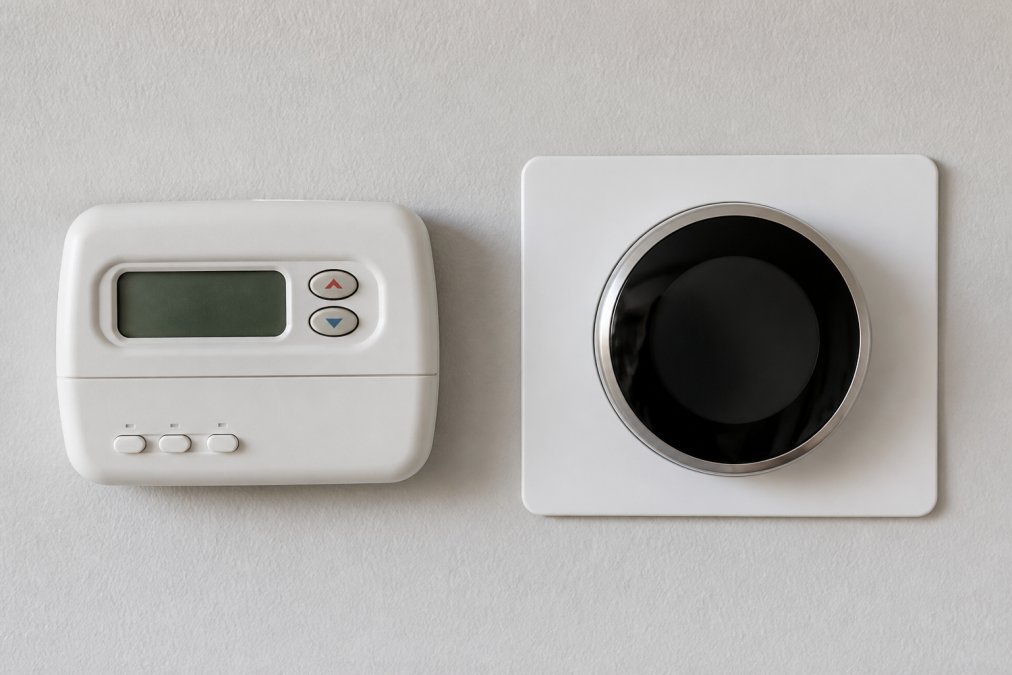
 blog
blog
Programmable vs Smart Thermostats: Key Benefits
Table of Contents
- How Programmable and Smart Thermostats Work
- Smart Thermostats: Wi-Fi Connectivity and Learning Algorithms
- Programmable vs Smart Thermostats: Key Differences at a Glance
- Smart Thermostat Energy Savings and Energy Efficiency
- Thermostat Installation Cost and Compatibility Factors
- Remote Access, Voice Control, and Smart Home Integration
- Data Privacy, Security, and Long-Term Hardware Lifespan
- Choosing the Right Thermostat for Your Home
- Frequently Asked Questions
Last Updated: September 25, 2026
How Programmable and Smart Thermostats Work
The benefits of programmable vs smart thermostats come down to one split: fixed schedules versus self-adjusting control. A programmable unit follows the times you set. A smart thermostat watches your habits and adjusts on its own.
At DC Plumbing Heating and Air Conditioning, we install and service both types across homes and businesses. Nearly 38 years in the field has taught us that the "better" option depends on your routine, your wiring, and your patience for setup.
Here's the short version before we get into detail:
- Programmable thermostats run on a schedule you build once.
- Smart thermostats use Wi-Fi connectivity and learning algorithms to adapt.
- Neither saves money if it's installed wrong or set up badly.
Below, we'll break down how each one works, what they cost to install, and which fits your home.
Programmable Thermostats: Set-and-Forget Temperature Scheduling
A programmable thermostat is a device that runs heating and cooling on a fixed schedule you enter manually, typically four blocks per day.
You pick the times and temps. It follows them exactly, every day, until you change them.
Most models support weekday and weekend schedules, plus a manual override button for odd days. The appeal is simple: set it once, then forget it.
The catch is that life isn't fixed. When your schedule shifts, the thermostat doesn't know. It keeps heating an empty house.
Smart Thermostats: Wi-Fi Connectivity and Learning Algorithms
A smart thermostat is a connected device that adjusts temperature automatically using sensors, your phone's location, and a learning algorithm that studies your patterns.
It links to your home Wi-Fi, so you control it from an app anywhere. Many models learn your routine within the first week or two and build a schedule on their own.
Some use occupancy sensors to detect when rooms are empty. Others use geofencing, which tracks whether your phone has left the area and dials back heating or cooling accordingly.
That's the core difference. One follows orders. The other takes initiative.
Programmable vs Smart Thermostats: Key Differences at a Glance
The main differences are scheduling, connectivity, learning, and cost. Here's how they stack up side by side.
| Feature | Programmable | Smart |
|---|---|---|
| Scheduling | Manual, fixed times | Automatic, self-adjusting |
| Wi-Fi connectivity | Rare | Standard |
| Remote access | No | Yes, via app |
| Learning algorithm | No | Yes |
| Geofencing | No | Yes |
| Voice control | No | Often |
| Installation complexity | Low | Moderate to high |
| Best for | Predictable routines | Changing schedules |
Neither wins across the board. A household with a fixed routine gets plenty from a programmable unit. A home with shifting hours gets more from a smart one.
Smart Thermostat Energy Savings and Energy Efficiency
Smart thermostat energy savings come from one habit: not heating or cooling an empty house. The device does that automatically, which is where the efficiency gain lives.
The U.S. Department of Energy guidance on thermostat savings notes that turning your thermostat back 7-10 degrees for eight hours a day can cut heating and cooling bills noticeably. A smart unit does this without you remembering to.
Programmable models can achieve similar results, but only if your schedule matches your settings. Miss that, and the savings shrink.
Usage Reports, Geofencing, and Adaptive Recovery
Three features drive most of the real-world savings:
- Usage reports show how long your system ran and when. They expose waste you'd never notice otherwise.
- Geofencing cuts heating or cooling when everyone leaves, then restores it before you're home.
- Adaptive recovery starts the system early so the house hits your target temp at the right time, without blasting full power.
Together, these turn energy efficiency from a guess into something you can actually see.
Thermostat Installation Cost and Compatibility Factors
Thermostat installation cost depends on three things: your wiring, your HVAC equipment, and whether a C-wire has to be run. A straight swap of a like-for-like unit is a 20-to-30-minute job. Adding a C-wire or moving a thermostat to a new wall can turn it into a half-day service call.
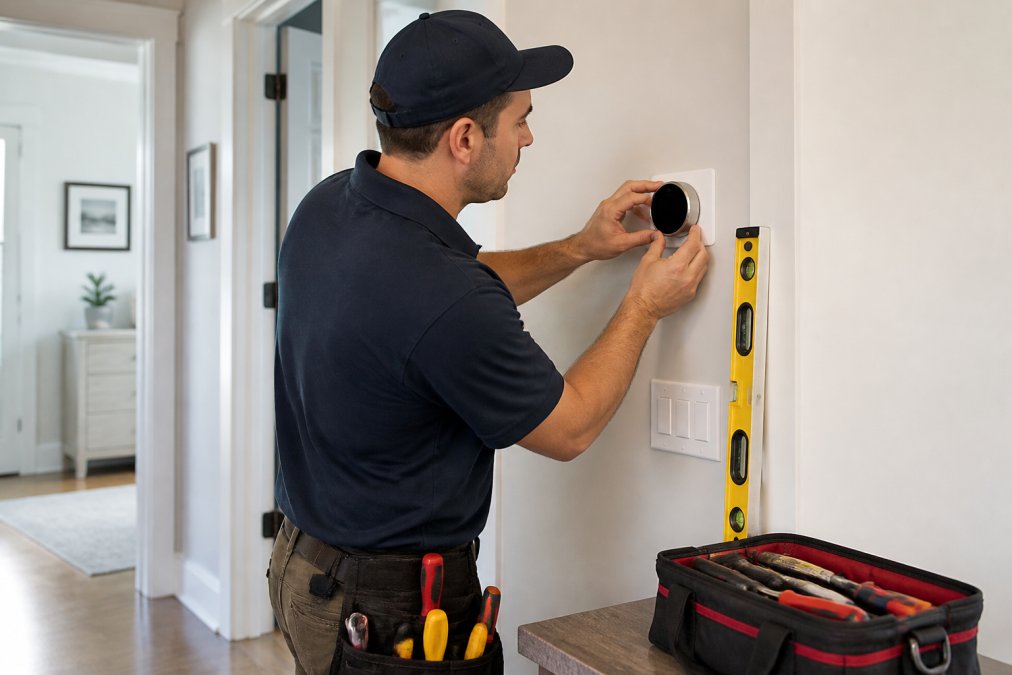
Most homeowners can replace a thermostat themselves when the wiring matches the old unit terminal-for-terminal.
C-Wire Requirements and HVAC System Compatibility
The C-wire (common wire) is a dedicated low-voltage conductor that supplies steady 24-volt power to the thermostat. Programmable units usually run on batteries, so they don't need it. Many smart models draw more current than batteries can supply, so they need a C-wire to stay powered and to keep the Wi-Fi radio alive.
- Does your current thermostat have a labeled C terminal, and is a wire actually landed on it?
- Is your system single-stage or multi-stage heating and cooling?
- Do you have a heat pump, a standard furnace with AC, or a dual-fuel setup?
- Is there a spare, unused conductor in the wall bundle you could repurpose?
If there's no C-wire, you have three real options:
- Run a new wire from the air handler or furnace to the thermostat. This is the cleanest fix and the one most techs recommend, but it can involve fishing wire through finished walls.
- Use a C-wire adapter that installs at the equipment and repurposes the existing conductors. It works on many single-stage systems but not all.
- Use a power-stealing kit or wall-plate adapter that comes with some smart models. These work in a narrower range of setups and can cause short-cycling on some equipment.
Remote Access, Voice Control, and Smart Home Integration
Remote access is the feature people notice most. You can adjust the temperature from your phone before you get home, or while you're away on a trip.
Data Privacy, Security, and Long-Term Hardware Lifespan
Two things most guides skip: data privacy and how long the hardware actually lasts. Both matter more than the spec sheet suggests, and both are reasons a buyer might reasonably choose a programmable unit over a smart one.
What a Connected Thermostat Actually Collects
A smart thermostat is a sensor package with a Wi-Fi radio. Depending on the model and how it's configured, it can collect:
-
Occupancy signals from motion or proximity sensors, which reveal when rooms are empty.
-
Location data from geofencing, which reveals when the house is unoccupied.
-
Runtime data, how long heating and cooling ran, at what outdoor temperatures, and how often the system cycled.
-
Setpoint history, which is a rough proxy for your daily routine.
-
Read the manufacturer's privacy policy and look specifically for whether data is shared with third parties or used for utility demand-response programs.
-
Turn off features you don't use. If you don't need geofencing, disable it, the location data stops flowing.
-
Check whether the device supports local-only control or a local API. Some models can be operated on your home network without routing commands through a cloud server.
-
Put the thermostat on a separate guest network if your router supports one, so a compromised device can't reach other hardware on your LAN.
Firmware, End-of-Support, and the Real Lifespan Question
On security, keep the device's firmware updates current. Outdated firmware is the most common weak point in a smart home ecosystem, and thermostat vendors don't patch forever. When a manufacturer ends support for a model, the cloud features can stop working and security fixes stop arriving, even though the hardware still runs.
Choosing the Right Thermostat for Your Home
Pick a programmable thermostat if your routine is predictable and you want a low-cost, low-maintenance upgrade. Pick a smart thermostat if your schedule changes, you want remote access, or you're building out home automation.
Ask yourself:
- Does my schedule change week to week?
- Do I want app or voice control?
- Does my system have a C-wire?
- Am I comfortable with a connected device on my network?
Frequently Asked Questions
What are the downsides of using a smart thermostat?
Smart thermostats can cost more upfront than programmable models and may require a C-wire for full functionality, which can add to thermostat installation cost. Some homeowners find the app setup and learning algorithm take time to adjust. Data privacy is another consideration, since these devices collect usage data. If your home has an older or multi-stage HVAC system, compatibility issues may arise. A licensed technician can confirm whether your system supports a smart model before you buy.
Does a programmable thermostat actually save money on utility bills?
Yes, when used consistently. A programmable thermostat saves money by lowering heating or cooling during hours when you are away or asleep, reducing energy consumption. The savings depend on your schedule, local climate, and how well you match settings to your routine. Homes that maintain a steady temperature all day see less benefit. Pairing a programmable schedule with regular HVAC maintenance helps you get the most from every degree you adjust.
Do smart thermostats require a C-wire for installation?
Many smart thermostats need a C-wire to supply constant power for Wi-Fi connectivity and the digital display. Some models work without one by drawing power from the heating and cooling wires, but this can cause short cycling or compatibility problems. If your home lacks a C-wire, a technician can often run one during thermostat installation. Checking compatibility before purchase avoids surprises and keeps your HVAC system running reliably.
Is it worth upgrading to a smart thermostat?
It depends on your priorities. A smart thermostat offers remote access, learning algorithms, geofencing, and usage reports that can trim energy consumption in homes with varied schedules. If you are often away or want voice control and smart home integration, the upgrade makes sense. For fixed routines, a programmable thermostat delivers solid savings at a lower thermostat installation cost. A qualified HVAC professional can assess your system and recommend the best fit.