 How-to
Garbage Disposal Hums but Won't Spin? Fix It Fast
Last Updated: October 23, 2026
Quick Summary
When your garbage disposal hums but won't spin, it is almost always jammed rather than dead, since the hum means the motor still has power. Cut the power at the switch and plug or breaker, then free the flywheel with a hex wrench turned back and forth until it rotates freely. Clear any visible debris with pliers or tongs, press the reset button, and wait 10 to 15 minutes before retrying.
- Never reach into the grinding chamber with bare hands; use pliers or tongs instead.
- Turn the hex wrench clockwise and counterclockwise until it rotates freely through a full rotation.
- Press the reset button firmly until you feel or hear a click, or it has not reset.
- Give the motor 10 to 15 minutes to cool after a trip before retrying.
- Run cold water for 15 to 30 seconds before and after switching the disposal on.
Table of Contents
- Why Your Garbage Disposal Hums but Won't Spin
- Turn Off the Power Before You Touch Anything
- How to Unjam a Garbage Disposal Safely
- Find and Press the Garbage Disposal Reset Button
- When a Garbage Disposal Hums but Is Not Jammed
- Check the Circuit Breaker and Power Supply
- Repair or Replace: When to Call a Plumber
- Frequently Asked Questions
Why Your Garbage Disposal Hums but Won't Spin
A garbage disposal that hums but won't spin is almost always jammed, not dead.
Here's the key distinction. A jammed disposal still has a working motor. A seized or burned-out motor does not. The hum tells you the motor is trying to turn.
So before you shop for a new unit, work through the checks below. Most people clear the jam in under ten minutes.
Turn Off the Power Before You Touch Anything
Safety comes first, and it's not optional. Before you touch the disposal, cut the power at two points.
- Flip the wall switch to OFF.
- Unplug the unit from the outlet under the sink, if it has a cord.
- If it's hardwired, switch off the breaker that feeds the disposal.
Why both steps? The wall switch can be bumped by someone else in the house.
Give the unit a minute before you proceed. Then confirm it's dead by flipping the switch on briefly.
This one step prevents the most common injury in disposal repairs: a motor that kicks on while a hand is inside the grinding chamber.
How to Unjam a Garbage Disposal Safely
Learning how to unjam a garbage disposal safely means freeing the flywheel without forcing the motor. The flywheel is the spinning disc at the base of the grinding chamber.
You have two paths: the wrench method from below, or clearing debris from above. Try the wrench first. It's cleaner and works for most jams.
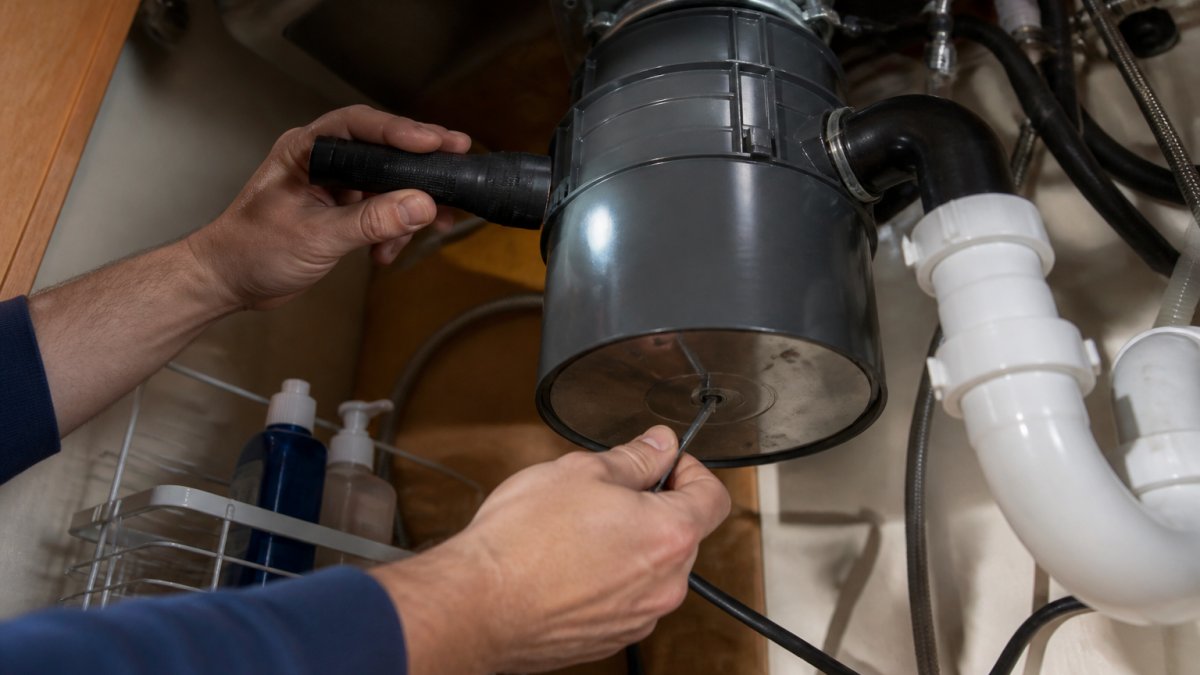
Free the Flywheel With a Hex Wrench
Most disposals ship with a hex wrench (also called an Allen wrench) designed for exactly this job.
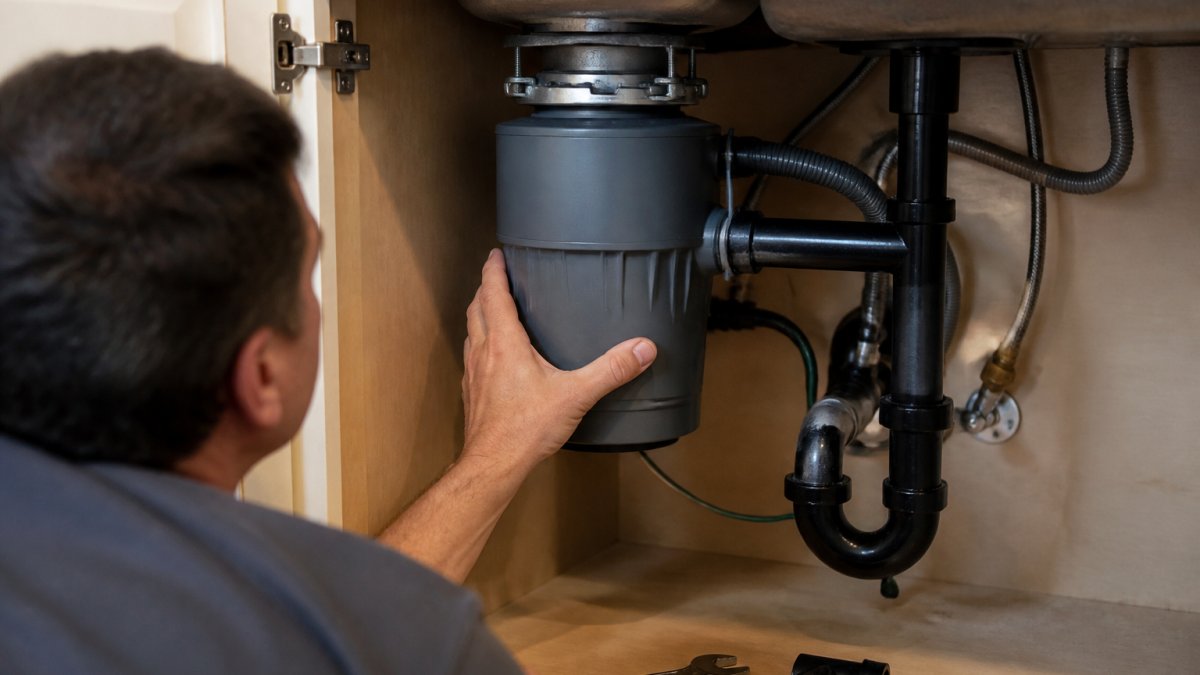
- Look under the sink at the bottom of the disposal. You'll see a socket in the center.
- Insert the hex wrench into that socket.
- Turn it back and forth, working it clockwise and counterclockwise.
- Keep working until the wrench turns freely through a full rotation.
The back-and-forth motion breaks the jam loose. Don't force it in one direction. Rock it gently until the flywheel gives.
Some models use a disposal wrench instead of a hex key. Same idea, different tool. Check your manual if the socket doesn't match.
Clear Visible Obstructions From the Grinding Chamber
If the wrench won't free it, something is lodged in the chamber. Shine a flashlight down into the sink drain.
Look for bones, fruit pits, silverware, or chunks of food waste. Use long-handled pliers or tongs to pull out anything you can see.
Once the chamber looks clear, try the wrench again. Then flush with running water before you restore power.
Find and Press the Garbage Disposal Reset Button
The garbage disposal reset button is a small red or black button on the bottom or side of the unit. It is a thermal overload protector: a bimetallic switch that opens the circuit when the motor windings get too hot, then closes again once they cool.
Here is the sequence that works, including the part most guides skip, the wait.
- With the power still off, locate the button under the sink. It is usually centered near the wrench socket, sometimes on the lower side of the housing.
- Press it firmly until you feel or hear a click. A soft press that does not click has not reset anything.
- Wait before you retry. Give the motor 10 to 15 minutes to cool after a trip. Retrying a hot motor immediately re-trips the overload and adds heat stress to windings that are already near their limit.
- Restore power and flip the wall switch for no more than 2 to 3 seconds. You are listening, not grinding.
- If it runs, you are done, proceed to flush with cold water. If it hums and stops again, the jam is not fully cleared. Cut power and go back to the wrench.
One Trip vs. Repeated Trips
The pattern of trips tells you what you are dealing with.
- One trip, then it runs after the jam is cleared: normal. The overload did its job.
- Trips again immediately after a 10-to-15-minute cool-down, with the flywheel confirmed free: the motor is drawing too much current for another reason, a failing start capacitor, seized bearings, or a winding fault. Stop resetting it.
- Trips the breaker at the panel rather than the unit's own button: that is an electrical fault, not a thermal overload. See the breaker section below and stop testing.
A common mistake is standing at the sink pressing the reset button every 30 seconds while the unit hums. Each retry pushes current through a hot motor. A handful of those cycles can turn a free fix into a replacement.
When a Garbage Disposal Hums but Is Not Jammed
Sometimes a garbage disposal hums but is not jammed. The flywheel spins freely by hand, yet the unit still won't grind. That points to a different problem.
Work through this short checklist:
- Is the flywheel actually free? Rotate it with the wrench. If it turns easily but the motor won't, the issue is electrical or mechanical, not a jam.
- Does the reset button keep tripping? Repeated trips suggest a failing motor or a wiring fault.
- Is the hum weak or strong? A weak hum with no movement can mean a failing start capacitor or a worn motor.
If the flywheel spins freely and the reset won't hold, stop troubleshooting. That's the point where a licensed technician should look at it. Forcing a motor that won't turn can burn it out for good.
Check the Circuit Breaker and Power Supply
A disposal needs a steady electrical supply. If the breaker tripped, the unit gets no power at all, so you'd hear nothing.
Check these:
- Open the breaker panel and look for a tripped breaker feeding the kitchen circuit.
- Reset it fully: flip it OFF, then firmly ON.
- Test the outlet under the sink with a small appliance.
If the breaker trips again the moment you switch the disposal on, stop. That's a sign of a short or a failing motor.
According to the U.S. Consumer Product Safety Commission, electrical faults around water are a leading cause of home injuries, so don't ignore a breaker that keeps tripping.
Repair or Replace: When to Call a Plumber
Most humming disposals just need a jam cleared. But some need real repair, and a few need replacing. The hard part is knowing which, and knowing when to stop troubleshooting before you make it worse. Use the table to identify the likely cause, then use the decision criteria below to choose a path.
| Symptom | Likely Cause | What to Do |
|---|---|---|
| Hums, won't spin, wrench frees it | Simple jam | Clear debris, reset, run cold water |
| Hums, wrench won't free it | Lodged object | Remove obstruction with pliers or tongs |
| Reset trips repeatedly after cool-down | Overheating motor, capacitor, or bearings | Stop resetting; call a licensed technician |
| Flywheel spins free, motor won't turn | Failing motor or start capacitor | Call a licensed technician |
| Breaker trips on switch-on | Electrical short | Stop and call a professional |
| Unit is old and leaks from the housing | Worn seals or cracked housing | Consider replacement |
When to Stop Troubleshooting
Stop and call a professional the moment any of these is true:
- The flywheel turns freely by hand but the motor still will not spin up.
- The reset trips again after a full 10-to-15-minute cool-down with the chamber confirmed clear.
- The breaker at the panel trips when you switch the unit on.
Each of these points away from a jam and toward a motor, capacitor, bearing, seal, or wiring problem. Continuing to reset and retry adds heat and current stress and can convert a repairable unit into a dead one.
Repair vs. Replace: The Decision Criteria
There is no universal rule, but most practitioners weigh the same handful of factors:
- Age. Disposals commonly last around 10 to 12 years with normal use. Past that range, a motor or seal failure is a signal to replace rather than repair.
- Leaks from the housing. A leak at the sink flange or drain connection is usually a gasket fix. A leak through the motor housing itself means the seal has failed and water has reached the windings, replacement is the practical answer.
- Recurring jams. One jam is an accident. Three in a season usually means the unit is undersized for the household, the impellers are worn, or habits need to change.
A common mistake is replacing a disposal that only needed a jam cleared. The opposite mistake, ignoring a motor that keeps tripping the reset, costs more, because repeated overheating can take out the breaker circuit or the wiring along with the unit.
Prevention: What Actually Causes Jams
Most jams are habit problems, not equipment problems. The items that cause the most trouble are fibrous and starchy food waste (celery, potato peels, corn husks), hard items (bones, fruit pits, coffee grounds in volume), and anything that expands in water (rice, pasta).
Habits that reduce jams:
- Run cold water before, during, and for 15 to 30 seconds after grinding. Cold water keeps grease solid so it moves through rather than coating the pipe.
- Feed waste in small batches rather than stuffing the chamber.
- Keep the splash guard in place and never use the sink as a temporary dish rack.
For homeowners and property managers, DC Plumbing Heating and Air Conditioning handles disposal repairs and replacements with upfront pricing and warranty-backed work.
Frequently Asked Questions
What does a jammed disposal sound like?
A jammed garbage disposal usually makes a low humming or buzzing sound without the grinding noise of normal operation. The motor is running, but the impellers and flywheel cannot turn because something is blocking the grinding chamber. You may also hear a faint click as the thermal overload trips. If the hum stops after a few seconds, that is the overload protecting the motor. Any humming with no spin means you should cut power and clear the jam before pressing reset.
How long should I wait before resetting a humming garbage disposal?
Wait at least 10 to 15 minutes after the disposal hums and stops before pressing the reset button. The thermal overload needs time to cool and reset internally. Pressing reset too soon can trip it again immediately or, worse, let the motor run while still jammed. Once the unit has cooled, clear the obstruction first, then press reset and test with cold water running. If it trips again right away, stop and call a licensed plumber.
Why does my garbage disposal hum even when it isn't jammed?
A garbage disposal hums but is not jammed when the motor is seized, the start winding has failed, or the flywheel is stuck against the housing from corrosion or debris buildup. It can also happen if the unit is not receiving full voltage from a weak breaker or loose connection. If you have cleared the grinding chamber and the flywheel spins freely by hand but the unit still hums without turning, the motor itself is likely failing and needs professional diagnosis.
When should I call a plumber for a garbage disposal that hums but won't spin?
Call a licensed plumber if the flywheel spins freely but the unit still hums, if the reset button trips repeatedly, if you see water leaking from the housing, or if the disposal is more than 10 years old. These signs point to a failed motor, seized bearings, or a worn unit that is not worth repairing. A plumber can confirm whether repair or replacement makes more sense and handle the electrical and plumbing connections safely.